CLIMB: Confidence-Guided Complementary Evidence for Multimodal Retrieval-Augmented Generation
EMNLP 2026 Findings
Abstract
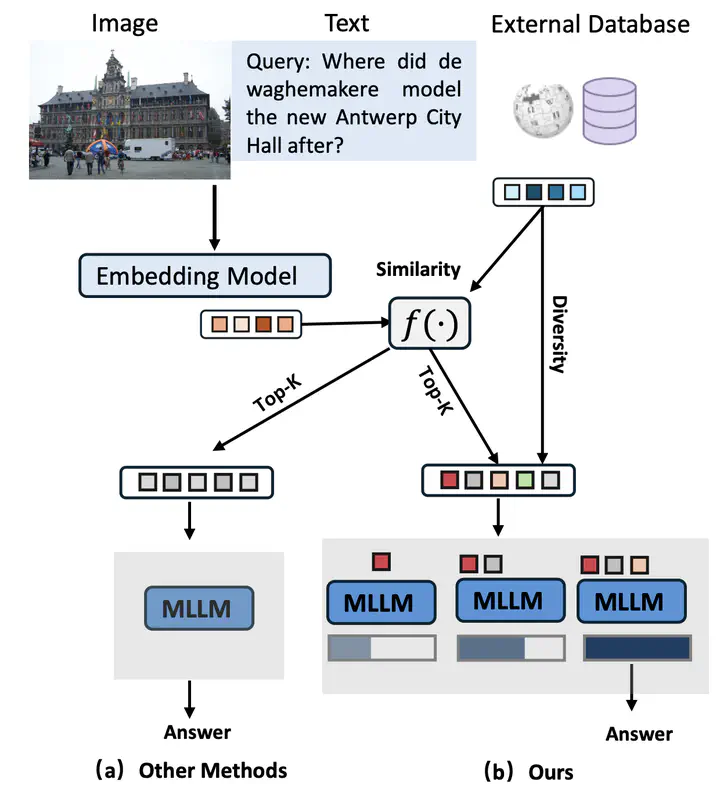
Multimodal large language models (MLLMs) have shown strong visual reasoning abilities, but knowledge-intensive visual question answering often requires external textual evidence beyond the image and the model’s parametric knowledge. Existing multimodal RAG systems commonly rely on Top-$K$ retrieval or reranking, which may return redundant passages and provide limited control over whether an answer update is sufficiently supported by the retrieved evidence. We propose \textit{CLIMB}, a training-free inference-time framework for multimodal RAG. CLIMB first constructs a compact complementary evidence pool using an MMR-style objective that balances query relevance and passage-level redundancy. It then performs confidence-controlled refinement within this fixed pool: an R/E/C critic scores passages by relevance, evidence specificity, and cross-modal alignment, while an evidence-grounded confidence estimator accepts an updated answer only when the estimated confidence increases. This design provides a simple stopping criterion and reduces unnecessary refinement without modifying the underlying retriever or MLLM. Experiments on Encyclopedic-VQA and InfoSeek show that CLIMB consistently improves over retrieval-augmented multimodal baselines. Ablations further indicate that complementary pooling, critic-based scoring, and iterative confidence-controlled refinement each contribute to the final performance.