Publications

Pooling and Semantic Shift: the Fundamental Challenge in Long Text Embedding and Retrieval

Abstract

Transformer-based embedding models frequently exhibit geometric pathologies, such as anisotropy and length-induced representation collapse, which can degrade downstream retrieval performance. While prior work often attributes these issues directly to text length or attention mechanisms, we argue that the fundamental drivers are instead the inherent pooling operations coupled with internal semantic shift. In this paper, we establish a unified theoretical framework proving that contextual pooling intrinsically causes embedding collapse. Specifically, we mathematically prove that pooling semantically diverse sentences inevitably leads to micro-level semantic dilution, and strictly reduces the Mean Pairwise Distance of the vector space, guaranteeing macro-level spatial concentration. Grounded in these geometric insights, we formally define semantic shift to capture the natural semantic evolution and dispersion within a text. Through carefully controlled experiments across diverse models and corpora, we disentangle text length from semantic content. We demonstrate that semantic shift is the primary predictor of severe embedding concentration. Crucially, our retrieval evaluations reveal that anisotropy is fundamentally harmful only when induced by strong semantic shifts, reconciling conflicting observations in prior literature and offering a principled explanation for the long-context challenges faced by modern embedding models and Large Language Models.

Pooling and Semantic Shift: the Fundamental Challenge in Long Text Embedding and Retrieval
CLIMB: Confidence-Guided Complementary Evidence for Multimodal Retrieval-Augmented Generation

Abstract

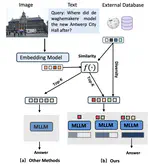
Multimodal large language models (MLLMs) have shown strong visual reasoning abilities, but knowledge-intensive visual question answering often requires external textual evidence beyond the image and the model’s parametric knowledge. Existing multimodal RAG systems commonly rely on Top-$K$ retrieval or reranking, which may return redundant passages and provide limited control over whether an answer update is sufficiently supported by the retrieved evidence. We propose \textit{CLIMB}, a training-free inference-time framework for multimodal RAG. CLIMB first constructs a compact complementary evidence pool using an MMR-style objective that balances query relevance and passage-level redundancy. It then performs confidence-controlled refinement within this fixed pool: an R/E/C critic scores passages by relevance, evidence specificity, and cross-modal alignment, while an evidence-grounded confidence estimator accepts an updated answer only when the estimated confidence increases. This design provides a simple stopping criterion and reduces unnecessary refinement without modifying the underlying retriever or MLLM. Experiments on Encyclopedic-VQA and InfoSeek show that CLIMB consistently improves over retrieval-augmented multimodal baselines. Ablations further indicate that complementary pooling, critic-based scoring, and iterative confidence-controlled refinement each contribute to the final performance.

CLIMB: Confidence-Guided Complementary Evidence for Multimodal Retrieval-Augmented Generation
A-MEM: Agentic Memory for LLM Agents

Abstract

While large language model (LLM) agents can effectively use external tools for complex real-world tasks, they require memory systems to leverage historical experiences. Current memory systems enable basic storage and retrieval but lack sophisticated memory organization, despite recent attempts to incorporate graph databases. Moreover, these systems’ fixed operations and structures limit their adaptability across diverse tasks. To address this limitation, this paper proposes a novel agentic memory system for LLM agents that can dynamically organize memories in an agentic way. Following the basic principles of the Zettelkasten method, we designed our memory system to create interconnected knowledge networks through dynamic indexing and linking. When a new memory is added, we generate a comprehensive note containing multiple structured attributes, including contextual descriptions, keywords, and tags. The system then analyzes historical memories to identify relevant connections, establishing links where meaningful similarities exist. Additionally, this process enables memory evolution - as new memories are integrated, they can trigger updates to the contextual representations and attributes of existing historical memories, allowing the memory network to continuously refine its understanding. Our approach combines the structured organization principles of Zettelkasten with the flexibility of agent-driven decision making, allowing for more adaptive and context-aware memory management. Empirical experiments on six foundation models show superior improvement against existing SOTA baselines.

A-MEM: Agentic Memory for LLM Agents
Task-Aligned Tool Recommendation for Large Language Models

Abstract

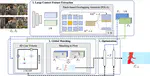
By augmenting Large Language Models (LLMs) with external tools, their capacity to solve complex problems has been significantly enhanced. However, despite ongoing advancements in the parsing capabilities of LLMs, incorporating all available tools simultaneously in the prompt remains impractical due to the vast number of external tools. Consequently, it is essential to provide LLMs with a precise set of tools tailored to the specific task, considering both quantity and quality. Current tool retrieval methods primarily focus on refining the ranking list of tools and directly packaging a fixed number of top-ranked tools as the tool set. However, these approaches often fail to equip LLMs with the optimal set of tools prior to execution, since the optimal number of tools for different tasks could be different, resulting in inefficiencies such as redundant or unsuitable tools, which impede immediate access to the most relevant tools. This paper addresses the challenge of recommending precise toolsets for LLMs. We introduce the problem of tool recommendation, define its scope, and propose a novel Precision-driven Tool Recommendation (PTR) approach. PTR captures an initial, concise set of tools by leveraging historical tool bundle usage and dynamically adjusts the tool set by performing tool matching, culminating in a multi-view-based tool addition. Additionally, we present a new dataset, RecTools, and a metric, TRACC, designed to evaluate the effectiveness of tool recommendation for LLMs. We further validate our design choices through comprehensive experiments, demonstrating promising accuracy across two open benchmarks and our RecTools dataset.
Task-Aligned Tool Recommendation for Large Language Models
Vector Retrieval with Similarity and Diversity: How Hard Is It?

Abstract

Dense vector retrieval is a fundamental building block of modern machine learning systems, underlying applications ranging from semantic search and recommendation to retrieval-augmented generation and knowledge-intensive reasoning. Beyond retrieving items that are individually similar to a query, many applications require a set of results that is also diverse, complementary, and collectively informative. Balancing similarity and diversity is therefore central to effective retrieval, but remains challenging to optimize in a stable and theoretically grounded way. Maximal Marginal Relevance (MMR) is a widly adopted heuristic for this problem, yet its reliance on a manually tuned parameter leads to optimization fluctuations and unpredictable retrieval results. More broadly, existing methods provide limited theoretical insight into how similarity and diversity interact in dense vector spaces, leaving the joint optimization problem insufficiently understood. To address these challenges, this paper introduces a novel approach that characterizes both constraints simultaneously by maximizing the similarity between the query vector and the sum of the selected candidate vectors. We formally define this optimization problem, Vectors Retrieval with Similarity and Diversity (VRSD) , and prove that it is NP-complete, establishing a rigorous theoretical bound on the inherent difficulty of this dual-objective retrieval. Subsequently, we present a parameter-free heuristic algorithm to solve VRSD. Extensive evaluations on multiple scientific QA datasets , incorporating both objective geometric metrics and LLM-simulated subjective assessments, demonstrate that our VRSD heuristic consistently outperforms established baselines, including MMR and Determinantal Point Processes (k-DPP).

Vector Retrieval with Similarity and Diversity: How Hard Is It?